AI and Mental Health: Can a Chatbot Really Replace Human Connection?
Artificial intelligence has quickly become part of everyday life. People use AI to write emails, answer questions, organize their schedules—and increasingly, to talk about their feelings.
For someone experiencing anxiety, loneliness, stress, or sadness, opening a chatbot can feel easier than making a therapy appointment. There is no waiting room, no scheduling, and no fear of being judged.
But as AI becomes more involved in our emotional lives, an important question is emerging:
Can AI provide mental-health support without replacing the human connection people need?
Why People Are Turning to AI for Emotional Support
There are understandable reasons someone might turn to AI when they’re struggling.
A person may not know where to begin with therapy. They may worry about the stigma surrounding mental health. They may have difficulty finding an appointment that fits their schedule. Or they may simply want someone—or something—to talk to at 2 a.m.
The American Psychological Association’s 2026 survey of more than 1,200 psychologists found that 77% had spoken with patients who had used AI for support or other reasons, while more than 90% reported concerns about some patients relying on chatbots for mental-health guidance.
AI can be a useful tool for gathering general information, organizing thoughts, or finding questions to discuss with a professional. But it isn’t the same thing as having a relationship with a trained mental-health professional.
What AI Can’t Replace
Therapy isn’t simply about receiving answers.
It’s about being known.
A therapist can listen to the words someone says while also paying attention to patterns, emotions, relationships, behavior, and changes over time. Therapy can help people explore the experiences underneath their symptoms and develop skills that fit their individual circumstances.
Human connection also provides something technology cannot fully duplicate: a genuine therapeutic relationship.
For someone struggling with anxiety, depression, trauma, relationship difficulties, parenting challenges, or emotional regulation, having a trained professional who can understand their unique situation can make an important difference.
What About Children and Teens?
This conversation becomes even more important when it involves young people.
Children and teenagers are growing up alongside technology, and many are comfortable communicating through screens. That doesn’t necessarily mean they have the emotional skills to determine when information from a chatbot is helpful—or when it may be reinforcing an unhealthy thought pattern.
Parents can help by asking open-ended questions:
- “What are you using AI for?”
- “What kinds of things are you talking about?”
- “How does it make you feel afterward?”
- “Would you feel comfortable talking to a person about the same thing?”
The goal doesn’t have to be fear or punishment. It can be curiosity, education, boundaries, and connection.
How MidWest Center Can Help
At MidWest Center for Personal & Family Development, we believe mental-health care should be personalized to the person—not reduced to a quick answer.
Our clinicians provide support for children, teens, adults, couples, and families dealing with a wide range of emotional and behavioral concerns. Treatment may include approaches such as cognitive behavioral therapy, trauma-informed care, family systems therapy, EMDR, and other individualized therapeutic approaches.
For individuals who may benefit from medication as part of their treatment plan, MidWest Center also provides medication-management services. Medication decisions are made based on the individual’s symptoms, history, goals, and needs.
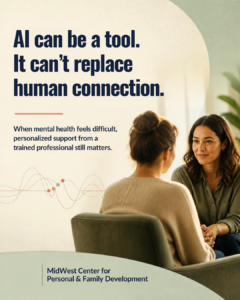
AI can be a tool.
But when you’re struggling, you don’t have to navigate everything alone.
Sometimes the most important conversation is the one you have with another human being.
If you or someone in your family is struggling with anxiety, depression, stress, relationships, trauma, or emotional well-being, MidWest Center can help you take the next step toward personalized support.